The Power of Perspective: Isometric Jet Airliner Flies over Blue S
In the vast landscape of digital design, few concepts capture the imagination quite like the intersection of travel, technology, and geometry. When we look at an Isometric Jet Airliner Flies over Blue S, we are not just seeing a picture of a plane; we are witnessing a specific visual language that has revolutionized how we communicate complex ideas in marketing, user interfaces, and technical documentation. This style, characterized by its unique three-dimensional perspective without vanishing points, offers a clarity that traditional photography or standard 2D illustrations simply cannot match.
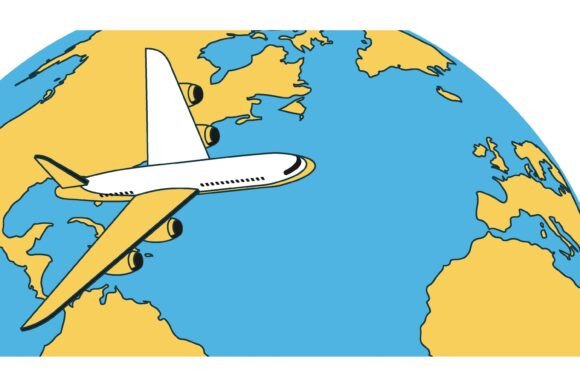
The imagery of an isometric jet airliner flying over a blue surface of planet Earth on an intercontinental flight over ocean serves as a perfect case study for this aesthetic. It combines the grandeur of global connectivity with the precision of vector art. By contrasting this design with a thin outline 3D vector isolated on white background, designers create a striking visual hierarchy that guides the viewer's eye while maintaining a sense of depth and scale. This approach is no longer just a trend; it is a fundamental tool in the modern creative toolkit.
Understanding the Geometry of Flight
To truly appreciate why an Isometric Jet Airliner Flies over Blue S resonates so well with audiences, one must first understand the mechanics behind the style. Isometric projection allows objects to be drawn with parallel lines remaining parallel throughout the image. Unlike perspective drawing, where lines converge at a vanishing point to simulate distance, isometric views keep all axes at 30-degree angles. This results in a representation where the object retains its true proportions from every angle.
When applied to aviation, this technique transforms a massive, complex machine into a manageable, understandable graphic. The jet airliner becomes a clean, geometric entity. The "Blue S" often represents the curvature of the earth or a stylized ocean path, providing context without overwhelming the subject. This balance is crucial. In a world saturated with information, the ability to present a concept—like an intercontinental flight over ocean—instantly and clearly is invaluable. The viewer immediately grasps the relationship between the aircraft and the globe without needing to decipher a photograph filled with clouds, lighting variations, or atmospheric distortion.
The Role of Contrast and Isolation
A key element that elevates these designs is the use of contrast. Consider the difference between a photorealistic rendering and a thin outline 3D vector isolated on white background. The latter strips away unnecessary details, focusing purely on form and function. This minimalism is powerful. When you isolate the jet on a white background, you remove all distractions. The focus shifts entirely to the silhouette, the wingspan, and the trajectory of the flight.
This isolation serves a practical purpose in modern workflows. Designers working on web applications, mobile apps, or corporate presentations need assets that are versatile. A high-resolution photo might be too heavy for a fast-loading website or might clash with a brand's color palette. However, a vector illustration of an isometric jet airliner flies over blue s can be scaled infinitely without losing quality. It can be recolored to match any brand identity, from a deep navy corporate blue to a vibrant tech green, while retaining its structural integrity.
The thin outline style adds another layer of sophistication. It suggests precision and engineering excellence. It implies that the subject is a product of careful calculation and design, much like the aircraft itself. This subtle psychological cue helps build trust with the audience. Whether you are selling airline tickets, promoting logistics software, or explaining supply chain routes, the clean lines of a vector graphic convey reliability and efficiency.
Integrating Aviation Graphics into Modern Workflows
The utility of an Isometric Jet Airliner Flies over Blue S extends far beyond simple decoration. In today's digital ecosystem, these graphics are integral to storytelling and data visualization. Take, for example, a logistics company trying to explain their global reach. A static map is boring, but an animated sequence featuring an isometric jet traversing a stylized blue ocean brings the data to life. It turns abstract numbers into a tangible journey.
Marketing teams are increasingly adopting this style for landing pages and social media campaigns. The visual metaphor of flight is universal. Everyone understands what it means to travel from point A to point B. By using a vector illustration that depicts an intercontinental flight over ocean, brands can instantly communicate speed, distance, and global presence. The "Blue S" acts as a dynamic canvas, allowing the plane to move across the screen in a way that feels organic yet controlled.
- Web Design: These vectors load quickly and render sharply on retina displays, improving user experience scores.
- App Interfaces: Developers use them to illustrate loading states or progress bars, making wait times feel more engaging.
- Presentation Decks: Executives use these graphics to simplify complex international strategies into single, impactful slides.
- Educational Content: Teachers and trainers use the clear geometry to explain aerodynamics or geography without getting bogged down in technical jargon.
The versatility of the thin outline 3D vector isolated on white background cannot be overstated. Because the background is removed, these assets can be dropped onto almost any texture or gradient. Imagine placing the jet over a textured paper background for a vintage travel poster vibe, or over a sleek, dark gradient for a futuristic tech launch. The adaptability ensures that the asset remains relevant even as design trends shift.
Practical Benefits for Designers and Businesses
For businesses, the decision to invest in custom isometric illustrations often comes down to differentiation. In a crowded market, standing out is essential. While stock photos of airplanes are readily available, they often look generic. A custom-designed isometric jet airliner flies over blue s creates a unique brand signature. It tells a story that is specific to the company's vision and values.
Furthermore, the production process for these graphics is highly efficient once the initial models are created. Vector files are non-destructive, meaning elements can be tweaked, resized, or reconfigured without starting from scratch. If a client wants to change the route of the flight or the type of aircraft, the designer can adjust the vector paths rather than commissioning a new photoshoot. This flexibility saves time and money in the long run.
From a user experience (UX) perspective, these graphics reduce cognitive load. When a user encounters a complex interface, such as a booking engine or a tracking dashboard, clear visual cues help them navigate the system. An icon of an isometric jet provides immediate context. It signals "flight," "travel," or "transportation" faster than text ever could. This speed of comprehension is critical in an era where users have short attention spans and high expectations for seamless interactions.
Navigating the Creative Process
Creating effective isometric artwork requires a blend of artistic skill and technical knowledge. Designers must consider the scale of the jet relative to the "Blue S" representing the Earth. If the plane is too small, it gets lost; if it is too large, the sense of scale is distorted. The goal is to find that sweet spot where the aircraft looks majestic yet grounded in reality.
Color theory also plays a significant role. The blue of the ocean or the planet's surface needs to complement the colors of the aircraft. Too much saturation can make the image pop off the screen in an unpleasant way, while too little can make it appear flat. The thin outline style helps mitigate this by defining edges clearly, ensuring that the separation between the jet and the background remains distinct regardless of the color choices.
As we look toward the future of digital design, the demand for high-quality, scalable, and meaningful visuals will only increase. The Isometric Jet Airliner Flies over Blue S is more than just a pretty picture; it is a testament to the power of simplification. It proves that by stripping away the noise and focusing on the essential forms, we can create images that are not only beautiful but also deeply functional.
Whether you are a graphic designer looking to expand your portfolio, a business owner seeking to elevate your brand, or a developer aiming to improve your application's interface, understanding the nuances of this style is essential. The ability to visualize an intercontinental flight over ocean through the lens of isometric projection opens up new avenues for creativity and communication. It bridges the gap between the physical world of travel and the digital world of information, creating a seamless experience for everyone involved.
In conclusion, the choice to utilize a thin outline 3D vector isolated on white background for aviation themes is a strategic one. It offers clarity, versatility, and a timeless aesthetic that transcends fleeting trends. As industries continue to evolve, the principles behind the Isometric Jet Airliner Flies over Blue S will remain a cornerstone of effective visual communication, guiding us through the complexities of a connected world with precision and grace.