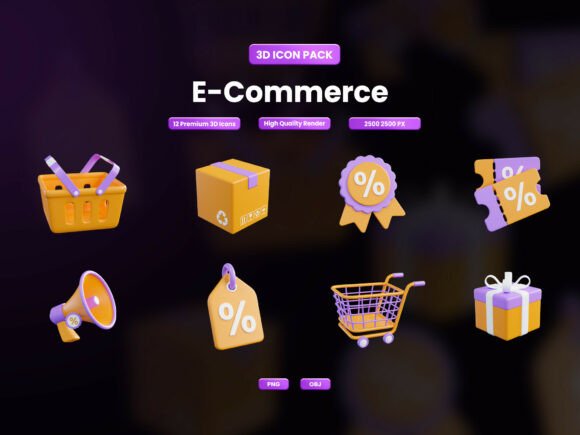
E-Commerce 3D Icon: A Strategic Asset for Digital Commerce
In the crowded landscape of online retail, visual clarity is not merely an aesthetic preference; it is a functional necessity. The E-Commerce 3D Icon pack represents more than just a collection of graphical files; it serves as a strategic tool for enhancing user experience, reinforcing brand identity, and streamlining communication in digital commerce environments. As businesses transition from flat, two-dimensional interfaces to immersive, tactile digital experiences, the adoption of high-quality 3D assets like this chubby-style icon set becomes a critical decision point for entrepreneurs, marketers, and product designers.
This specific asset pack brings essential concepts—shopping carts, delivery boxes, vouchers, and discount tags—to life with vibrant commercial colors and smooth rendering. However, simply downloading these files does not guarantee success. To derive true value, one must understand how to integrate the E-Commerce 3D Icon into a broader design system that supports business goals, improves conversion rates, and maintains operational consistency across platforms.
The Strategic Value of Tactile Visuals in Online Retail
The shift toward 3D graphics in e-commerce is driven by a fundamental psychological need for tangibility. When a customer cannot physically touch a product or feel the weight of a package, the interface must compensate by providing visual cues that suggest depth and substance. The E-Commerce 3D Icon addresses this by utilizing a "chubby" design language that mimics physical objects. This style reduces cognitive load, allowing users to instantly recognize functions such as "checkout," "shipping," or "promotion" without needing to read extensive text labels.
For marketplace apps and fintech services, where trust and speed are paramount, these icons act as visual anchors. A high-resolution shopping cart icon rendered with soft lighting and realistic shadows can subconsciously signal reliability and modernity. Conversely, a generic, low-resolution clip art can undermine the perceived value of the platform. By deploying the E-Commerce 3D Icon strategically, brands can elevate their positioning from a basic transactional site to a premium digital destination.
The inclusion of specific elements like vouchers and discount tags further enhances this strategy. In sales promotion presentations and live campaign dashboards, these icons serve as immediate indicators of value. They guide the user's eye toward high-priority actions, effectively increasing click-through rates on promotional offers. The vibrant commercial colors inherent in the pack are designed to stand out against standard UI backgrounds, ensuring that key calls-to-action remain visible even in complex layouts.
Integrating Assets into Brand Identity and User Experience
Successful integration of the E-Commerce 3D Icon requires a deliberate approach to branding. These assets should not be treated as isolated decorations but as integral components of a cohesive visual language. For startup digital commerce branding, consistency is key. If a brand chooses the playful, rounded aesthetic of this icon pack, that tone should permeate other design elements, from typography to button shapes.
Consider the application in retail shopping platforms. A unified visual system helps users navigate complex inventories with confidence. When a delivery box icon appears consistently across the checkout flow, the order confirmation page, and the tracking portal, it creates a seamless narrative. This continuity reduces friction and builds familiarity, which are essential for long-term customer retention. The E-Commerce 3D Icon provides a standardized look that prevents the disjointed feel often caused by mixing disparate graphic styles.
Furthermore, the technical specifications of the pack support scalability. With nine PNG files available at 2500x2500 pixels with transparent backgrounds, these icons are future-proofed for various display requirements. Whether displayed on a small mobile screen or a large desktop monitor, the high-resolution 3D renders maintain their integrity. This flexibility allows marketing teams to repurpose assets for social media campaigns, email headers, and presentation decks without worrying about pixelation or loss of detail.
Decision-Making Frameworks for Implementation
Before committing to the E-Commerce 3D Icon, decision-makers should evaluate their current design ecosystem. Is the existing interface too cluttered? Does the current branding lack a distinct personality? Are conversion metrics lagging on specific pages where visual cues could clarify the next step? Answering these questions determines whether this asset pack will solve a problem or merely add noise.
A practical approach involves mapping out user journeys and identifying pain points. For instance, if data shows that users frequently abandon their carts during the payment phase, introducing a clear, friendly 3D voucher or discount tag icon might reduce anxiety and encourage completion. Similarly, if a new marketplace app struggles to communicate its shipping benefits, a prominent, high-quality delivery box icon can instantly convey speed and security.
Planning for implementation also involves considering the target audience. While the playful, chubby design appeals broadly to adults aged 20–50, including hobbyists and small business owners, it may not suit every niche. Luxury brands seeking a minimalist, austere aesthetic might find the vibrant commercial colors too aggressive. Therefore, the decision to use the E-Commerce 3D Icon should align with the brand's core values and the expectations of its specific demographic.
Practical Use Cases and Operational Efficiency
- Online Store Navigation: Replace standard text links with intuitive 3D icons for categories like "New Arrivals," "Sale," and "Best Sellers" to improve scanability.
- Sales Promotion Presentations: Utilize the discount tag and voucher icons in pitch decks to visually represent growth strategies and revenue models to stakeholders.
- Fintech Services: Integrate the shopping cart and payment-related visuals into wallet apps to simplify the understanding of transaction flows.
- Startup Branding: Establish a memorable visual identity quickly by using these ready-to-use assets as placeholders while custom illustrations are developed.
Risks of Unintentional Usage and Contextual Mismatch
Despite their versatility, the E-Commerce 3D Icon assets carry risks if deployed without clear goals. The most common pitfall is visual inconsistency. Using these vibrant, chubby icons alongside sharp, angular, or monochromatic design elements can create a jarring experience that confuses users and dilutes brand authority. It is crucial to ensure that the 3D style complements the overall UI/UX rather than competing with it.
Another risk lies in over-reliance on graphics at the expense of functionality. An icon, no matter how beautifully rendered, cannot replace clear labeling or accessible navigation structures. If a user cannot determine what an icon represents because the context is missing, the asset fails its primary purpose. Designers must always prioritize clarity over creativity, ensuring that the E-Commerce 3D Icon supports, rather than obscures, the message.
Additionally, there is the risk of homogenization. Since these types of assets are becoming increasingly popular, relying solely on stock imagery can make a brand appear generic. To mitigate this, businesses should consider customizing the color palette of the icons to match their specific brand guidelines or combining them with unique photography and typography to create a distinctive look.
Long-Term Value and Sustainable Growth
When used intentionally, the E-Commerce 3D Icon contributes to sustainable growth by fostering a positive user experience. High-quality visuals build trust, and trust drives repeat purchases. Over time, a consistent and polished visual identity becomes a competitive advantage, distinguishing a platform in a saturated market. The investment in professional-grade assets pays dividends through improved engagement metrics and reduced bounce rates.
Moreover, the adaptability of these icons ensures longevity. As digital trends evolve, the ability to scale and reposition these assets allows brands to stay relevant without constantly commissioning new graphics. The transparent background and high resolution mean they can be integrated into emerging formats, from augmented reality overlays to interactive web experiences, extending their utility well beyond initial deployment.
Ultimately, the decision to incorporate the E-Commerce 3D Icon into a digital strategy should be viewed as a calculated move toward better communication and stronger branding. By focusing on strategic alignment, contextual appropriateness, and user-centric design, businesses can leverage these creative assets to achieve tangible results. The goal is not just to look good, but to function better, guiding customers seamlessly through the journey from discovery to purchase.